From 2020 to 2024, the Urban Institute led the Prison Research and Innovation Initiative (PRII), an effort to increase transparency and accountability in prisons. Using climate surveys, administrative data, and a participatory research approach, PRII examined prison conditions and tested reforms to improve living and working conditions.
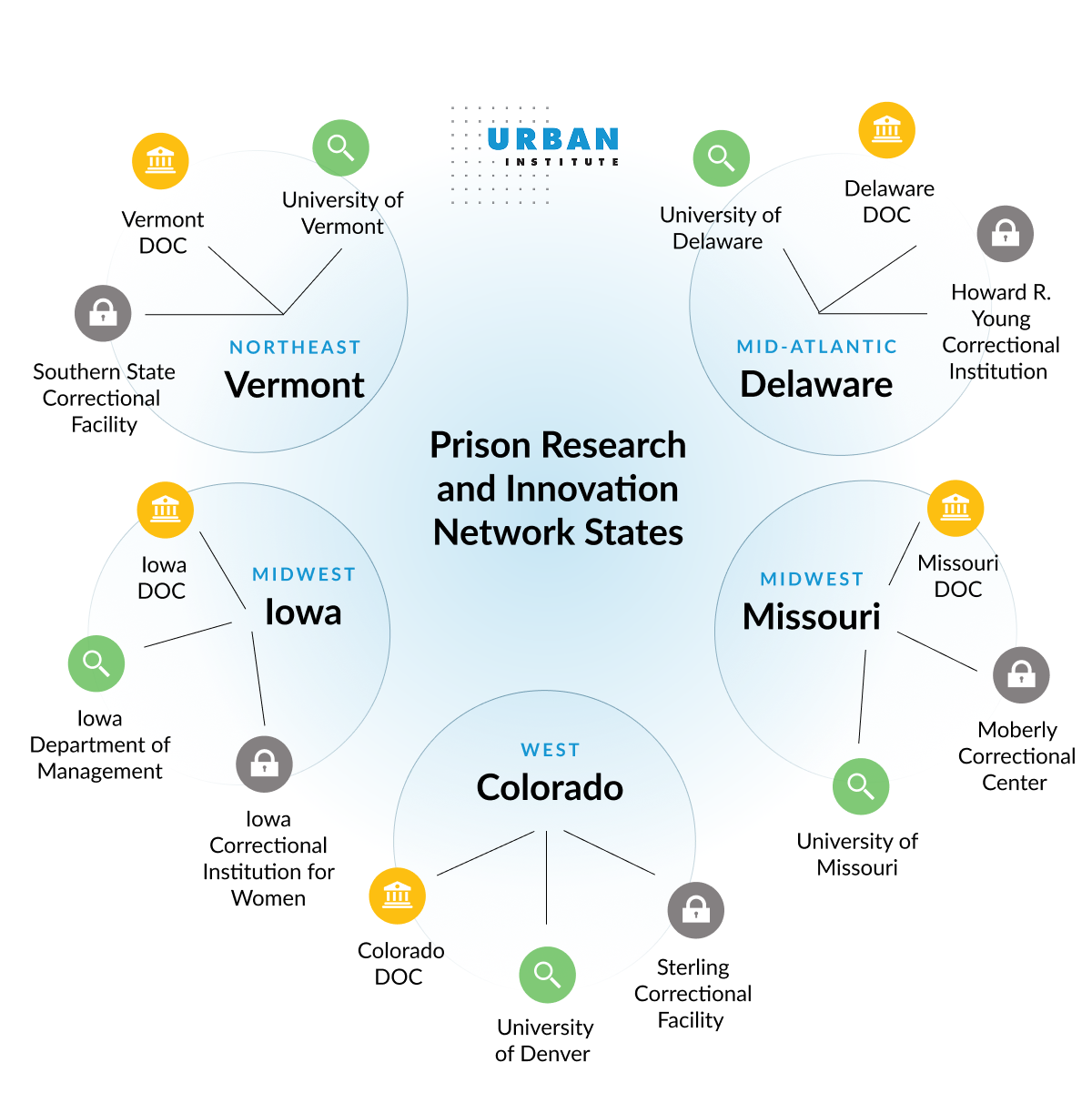
PRII established the Prison Research and Innovation Network (PRIN), a consortium of five pilot sites in Colorado, Delaware, Iowa, Missouri, and Vermont. At each site, corrections agencies worked with research partners and advisory councils of incarcerated people and correction staff to use data and lived experience to drive humane, safe, and rehabilitative reforms.
Explore the publications Urban created as part of the Prison Research and Innovation Initiative below.
Explore a collection of insights from our local partners.
Colorado
Team: Colorado Department of Corrections, Sterling Correctional Facility, and University of Denver
- Sterling Correctional Facility PRIN Report (2022) (PDF)
- SCF Data Report: Incarcerated People Survey Results Comparison 2021-2023 (PDF)
- SCF Data Report: Staff Survey Results Comparison 2021-2023 (PDF)
- DU-Led Research Project at Colorado Prison to Drive Innovative Changes to the Prison Environment
- The Wall Has No Name: The Persistence of the Prison in the Face of Change
Delaware
Team: Delaware Department of Correction, University of Delaware, and Howard R. Young Correctional Institution
- How to Listen Through a Wall: Lessons From Conducting Participatory Action Research in an Urban Prison
- “This Place Will Wear You Down”: Examining the Organizational and Contagion Effects of Stress on Correctional Staff Working Overtime in U.S. Prisons
- Participatory Action Research in a Pandemic: Prison Climates During COVID-19
- Changing Prisons to Help People Change
Iowa
Team: Iowa Department of Corrections, Iowa Correctional Institution for Women, and Iowa Department of Management
- Community-Based Participatory Research (CBPR) With Incarcerated Women: Exploring the Role of Prison Activities as a Determinant of Preparedness for Re-entry
- Organizational Climate and its Impact in a Women’s Prison on the Mental Health of Correctional Staff
Missouri
Team: Missouri Department of Corrections, Moberly Correctional Center, and University of Missouri
- Community-engaged prison-based research in a pandemic: the efficacy of summative content analysis for understanding prison culture and climate
- Increasing Capacity for Community-Engaged Research in Prisons: The Utility of a Basic Research Short Course
- The New Age Worker: Morale and Strain Among Staff During a Correctional Staffing Crisis
- “Cameras Help, but Hurt”: The Role and Use of Prison Cameras for Accountability
- Perceptions of Vaccine Safety and Hesitancy among Incarcerated Adults and Correctional Staff in the Rural Midwest
Vermont
Team: Vermont Department of Corrections, Southern State Correctional Facility, and University of Vermont
- Vermont Prison Climate Surveys 2021 (PDF)
- Vermont Prison Climate Survey 2022 (PDF)
- Vermont Prison Climate Survey 2024 (PDF)
- Using a Community-Engaged Survey to Describe Prison Environments and Measure the Mental Health Status of Correctional Staff and Incarcerated Individuals
- Idle Time in Prison: The Emotional, Social, and Practical Impacts of Incapacitation
- Vermont Department of Corrections' PRIN webpage
The initiative was guided by three goals:
- Develop a better understanding of prison environments and how they shape the safety and well-being of the people who are confined and work in them.
- Enhance prisons’ capacity to collect data on prison environments, with the goal of promoting transparency and accountability.
- Design, implement, and evaluate evidence-based operational and programmatic innovations to improve basic conditions.
Independent researchers from five states partnered with their respective state departments of corrections to improve data collection and transparency.
Each state team used participatory research approaches to work directly with incarcerated people and corrections staff to develop and administer an annual climate survey of prison conditions. Across three waves, these surveys captured incarcerated people’s and corrections staff’s perspectives on prison living and working conditions. The survey results were used to make evidence-based improvements in living and working conditions in each facility.
Through these efforts, the initiative generated one of the few multistate datasets on the experiences of incarcerated people and corrections staff.
In its role as consortium coordinator, the Urban Institute completed a process evaluation to understand how prison-based participatory research worked in each site. For this, we conducted interviews at multiple points in time with people involved in the consortium from each state, including people who were incarcerated, corrections staff, facility leadership, local research partners, and state-level leaders who advised on the project via executive committees.
We learned from our local partners that although participatory research approaches are uniquely challenging to conduct in prison settings, when done with intentionality they are not only possible but can lead to actionable insights and meaningful changes.